Why is a charger planned on my street, and who pays for it?
The City has marked the kerb outside 33 Forbes Street as a place for a public charger, and neighbours have been pulling permits for chargers of their own. Why here, and who is paying?
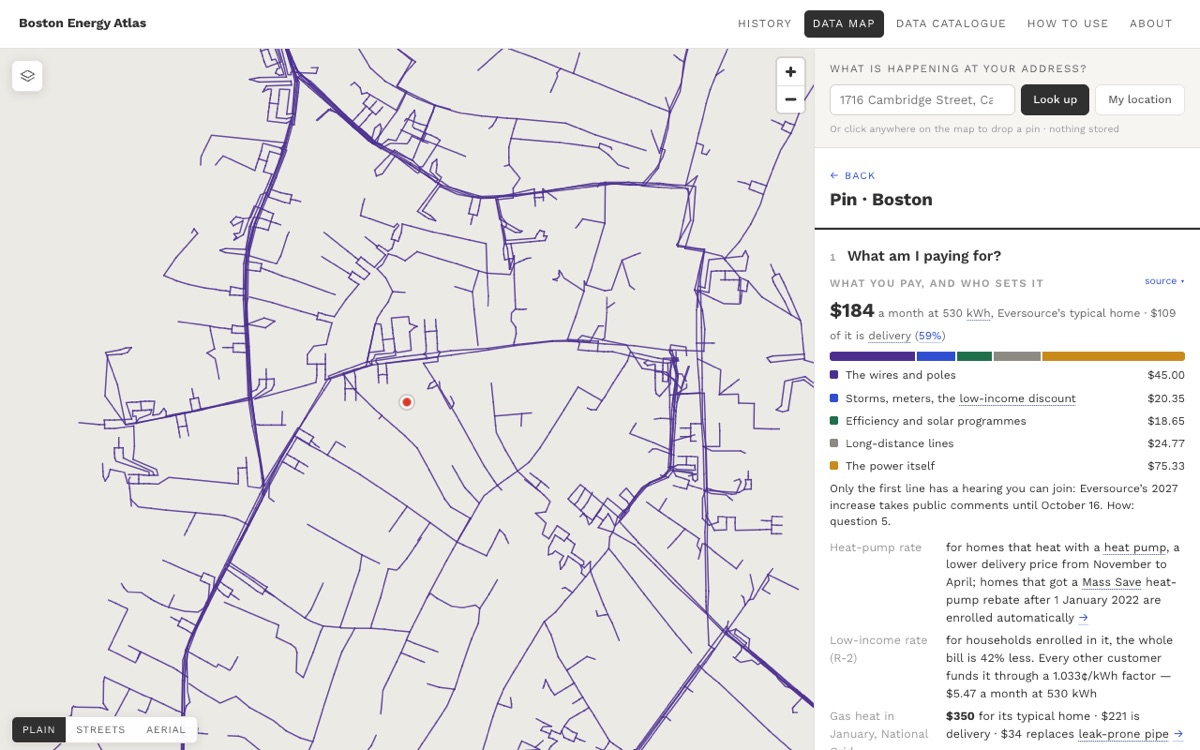
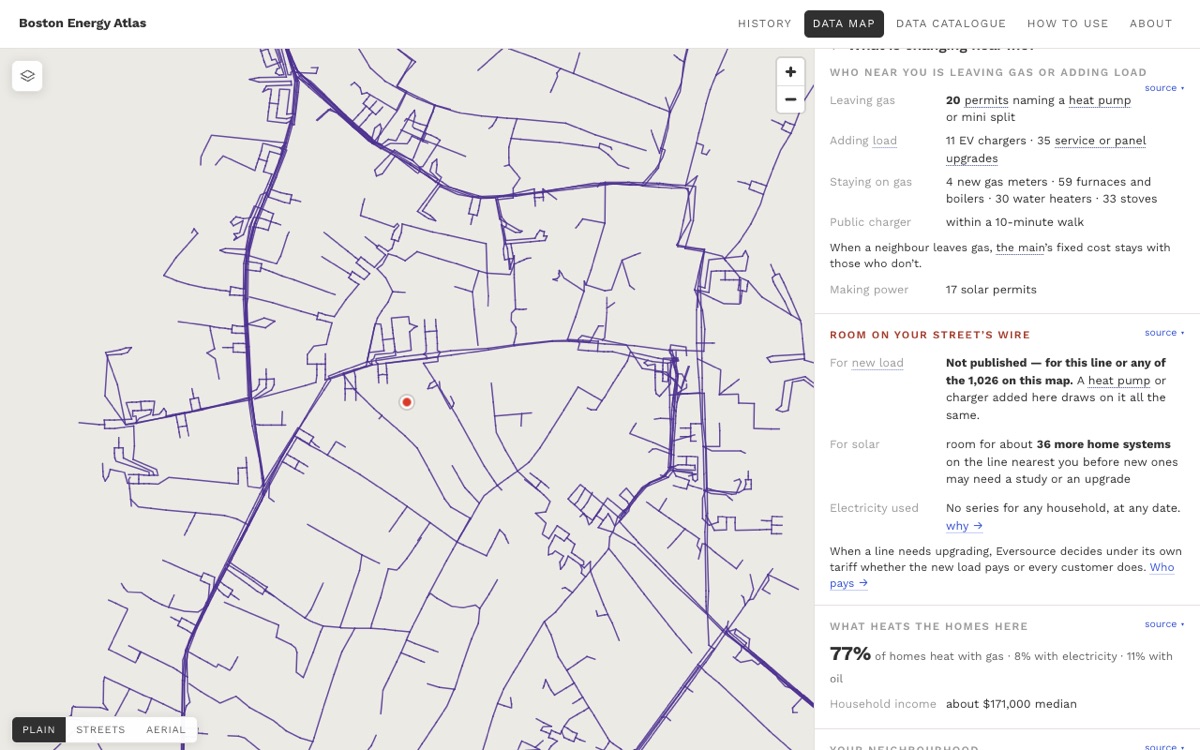
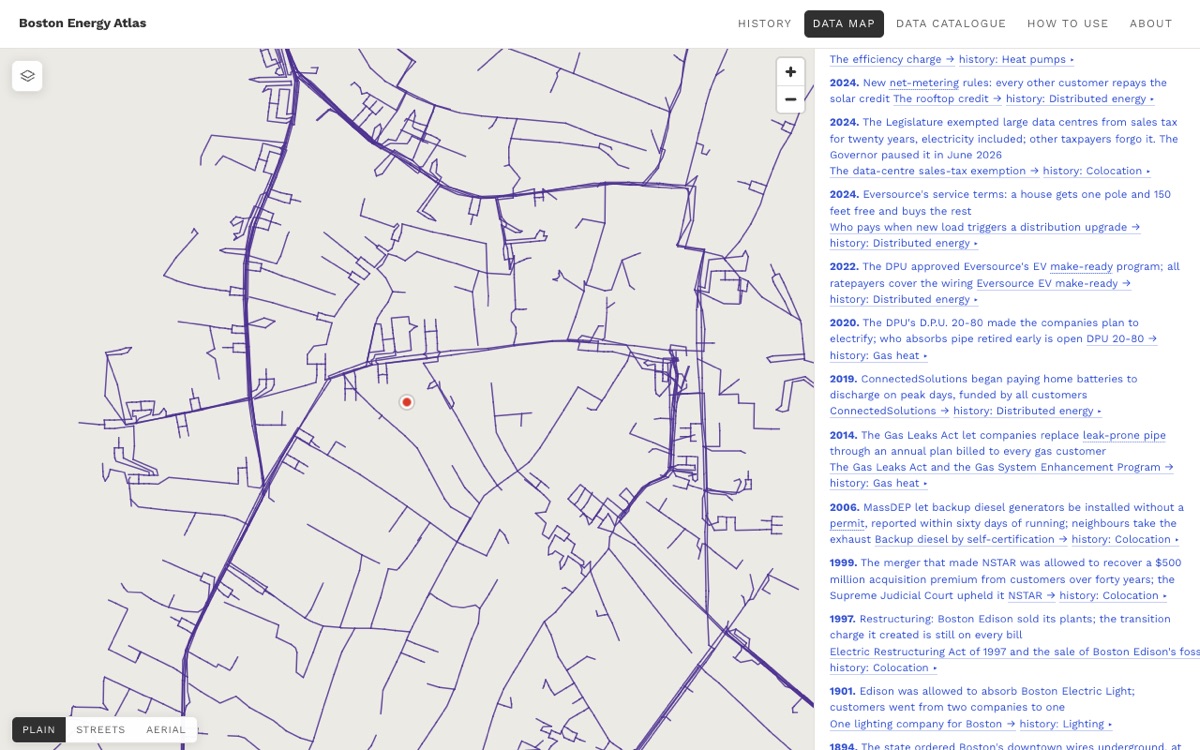
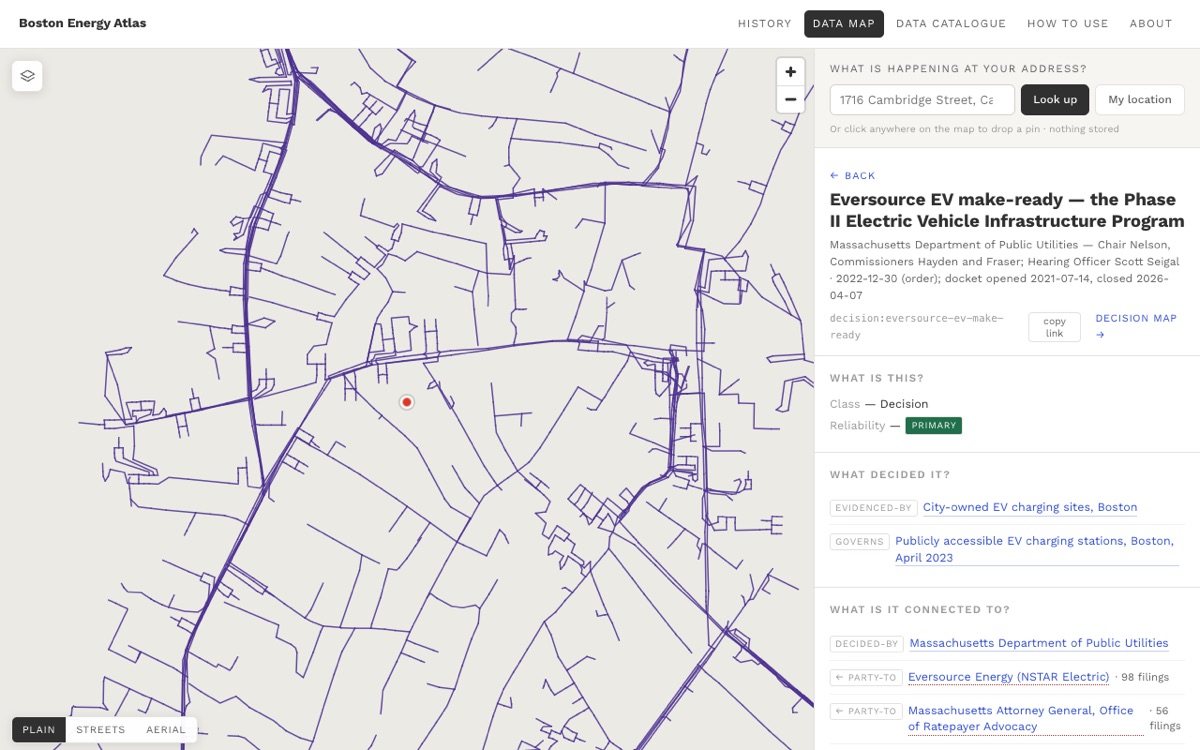
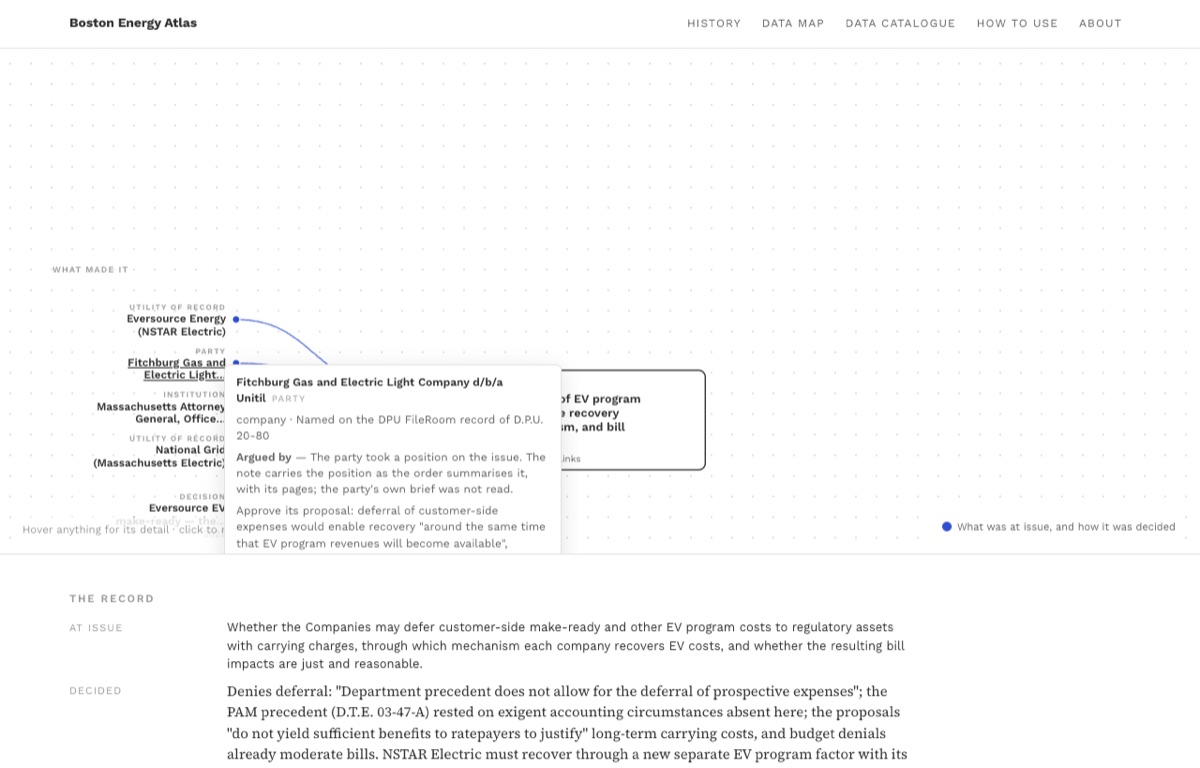
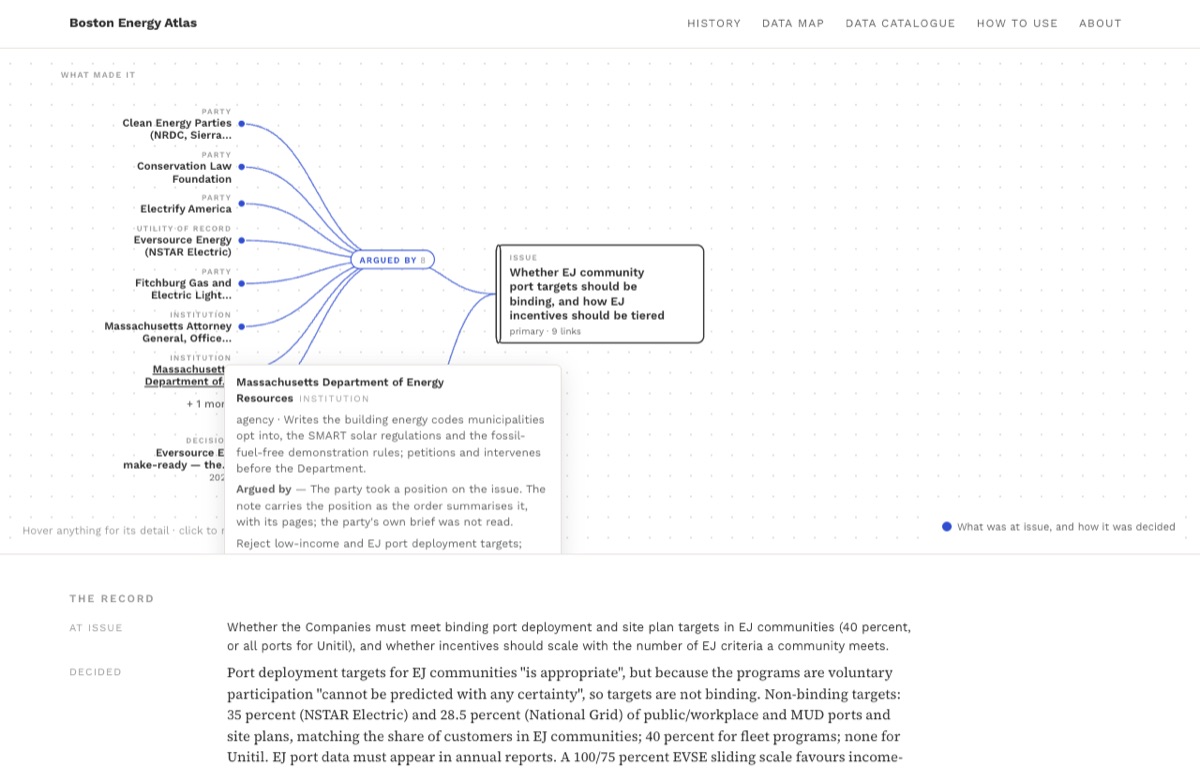
Read it step by step insteadscreenshots and text, with a link to each step1Look up the address. On the data map, type 24 Forbes Street, Boston and press Look up, or click the street. The panel on the right answers five questions for that point, starting with the bill. open this step →2What is changing near you. Scroll to “Who near you is leaving gas or adding load”: within 300 m, 11 permits for EV chargers and 35 service or panel upgrades, and a public charger within a ten-minute walk. The layers button at the top left of the map adds “Candidate charging sites”, the kerbs the City scored in its suitability analysis; 33 Forbes Street is one of them, tier 2. Each line has a “source” link.3What decided this. Further down, the decisions that reach this address, newest first. The line for 2022 reads: the DPU approved Eversource’s EV make-ready programme; all ratepayers cover the wiring. Open it.4The decision. Decided on 30 December 2022 by the Department of Public Utilities, Chair Nelson with Commissioners Hayden and Fraser, in docket D.P.U. 21-90. The card lists the layers it governs. Follow “decision map →”. open this step →5The decision map. On the left, what made it: the DPU decided, Eversource asked, 29 parties took part. On the right, what it made: the layers it governs and the 32 questions the order had to decide. Hover anything for its detail; click to move the centre. open this step →6Who pays. Open the issue “Deferral of EV program costs, the recovery mechanism, and bill impacts”. The companies asked to defer the costs with a carrying charge; the Attorney General objected; the Department denied the deferral and ordered a separate EV programme factor with its own line on every bill. Each page number opens the order at that page. open this step →
What the resident learns
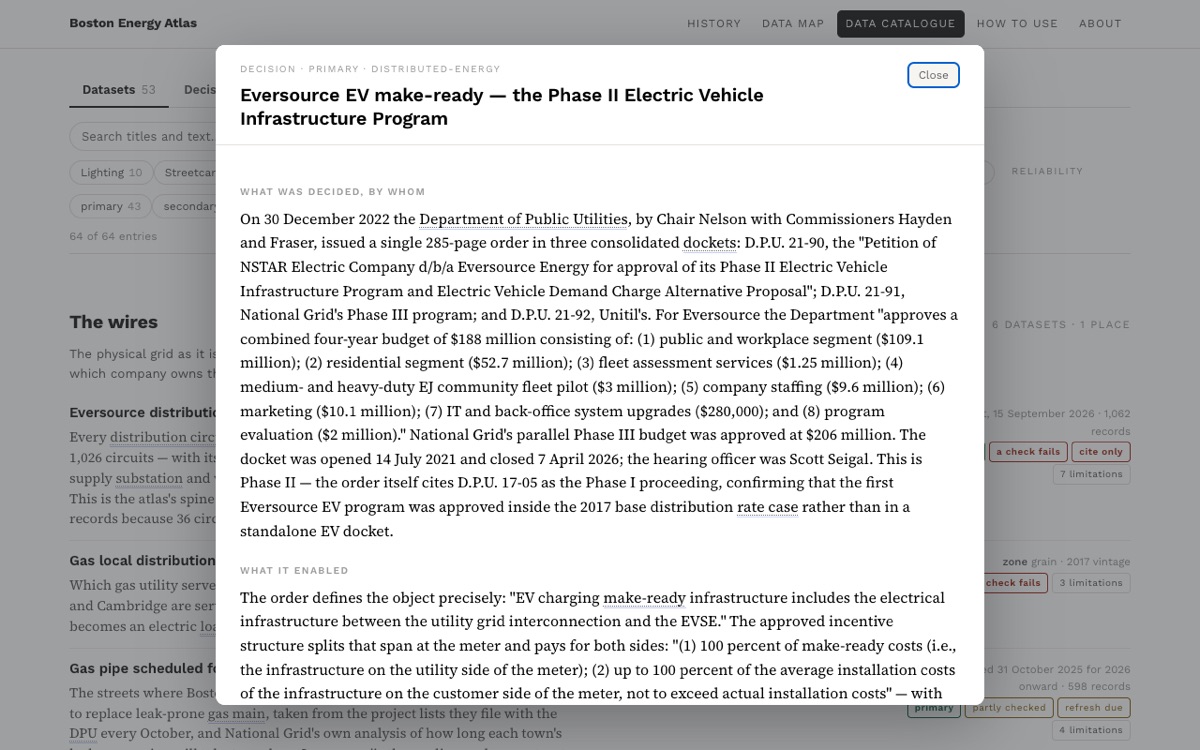
The wiring to a charger built under the programme is paid by every Eversource customer, through a line on the bill; the company’s own exhibit put it at 15 to 21 cents a month for a typical home. The chargers on the street are permits by neighbours; the kerb outside number 33 is a candidate the City scored, not a charger yet.
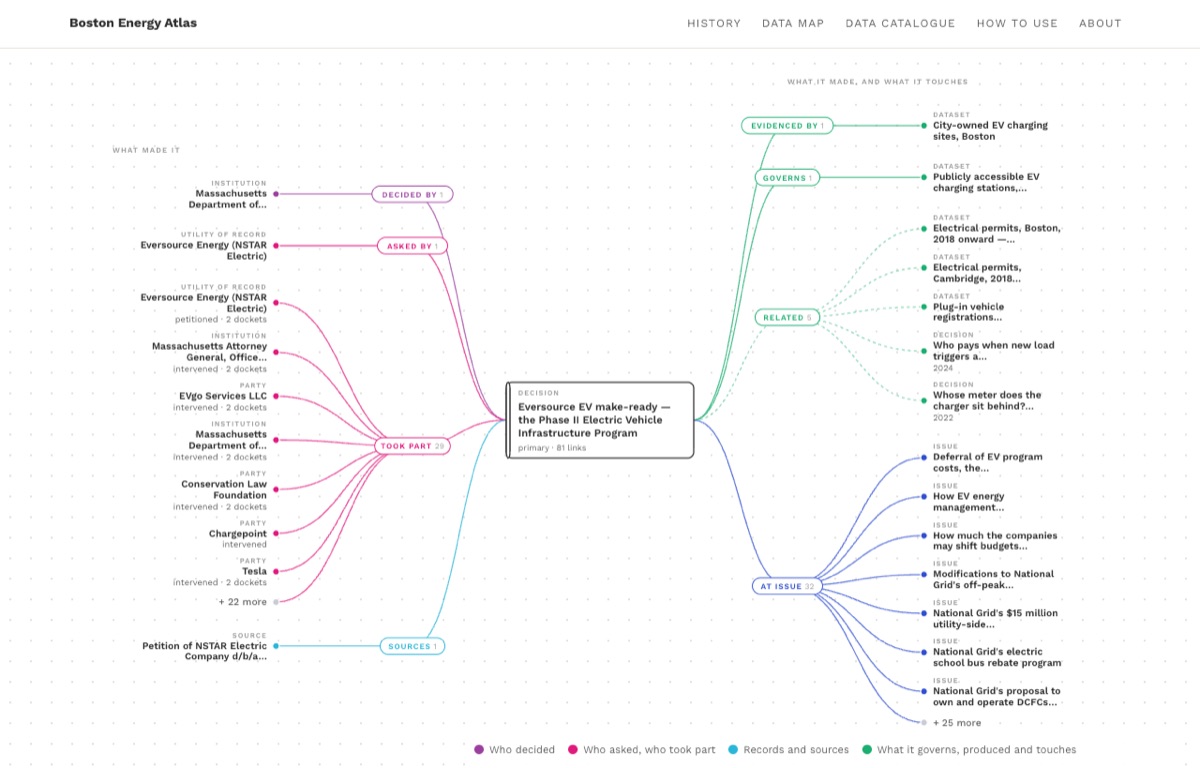
Where it stops
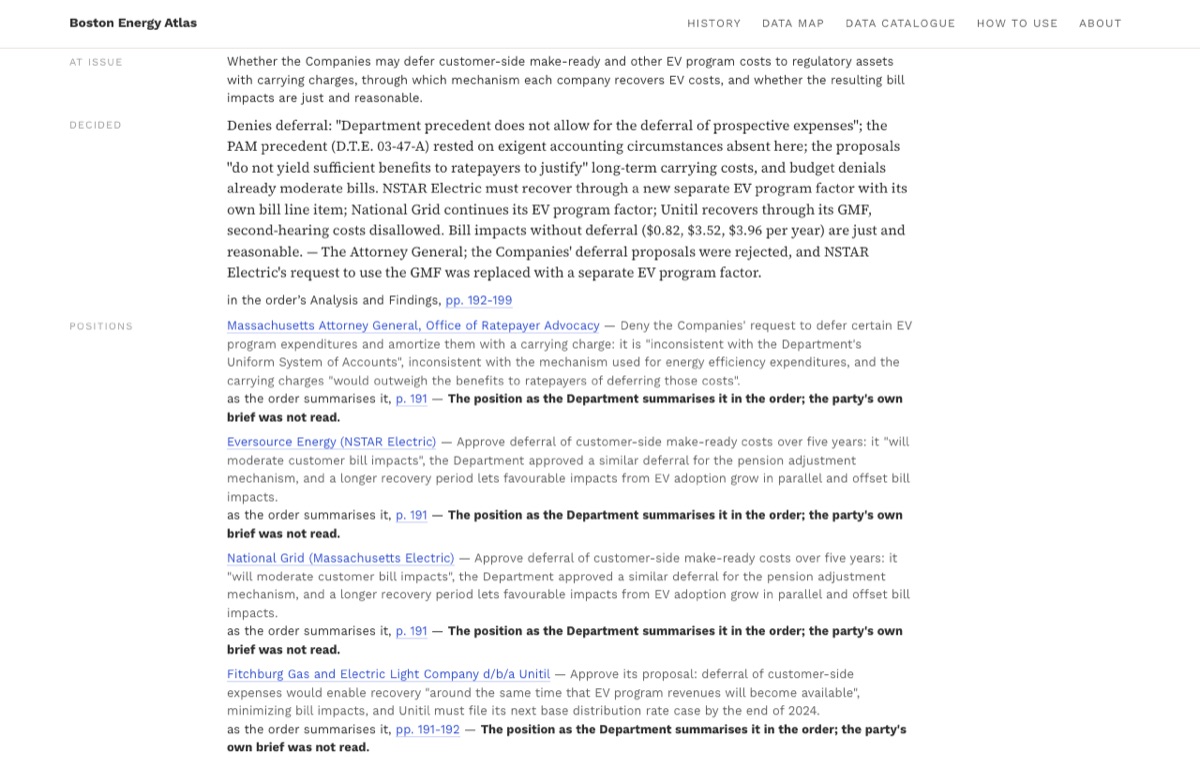
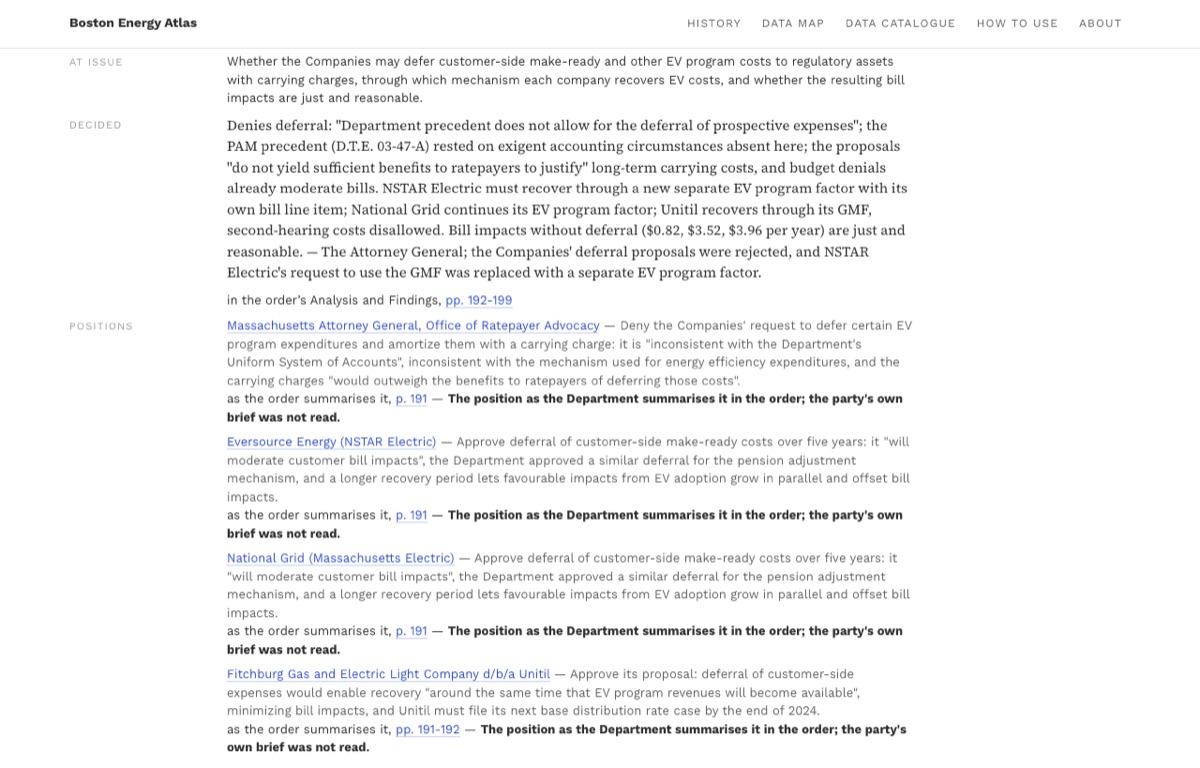
The atlas can say under which programme and whose money, not why this kerb rather than the next: the City’s analysis gives each kerb a tier, not a reason, and the decision that commissioned that analysis is not in the record yet. Whether the programme must site chargers strategically was itself one of the 32 issues.
An advocate · a ratepayer group
Did anyone object to every ratepayer paying for the chargers, and did it work?
Eversource asked to spread the cost of charger wiring across every customer, with interest. Did anyone push back, what exactly did they say, and did the Department listen?
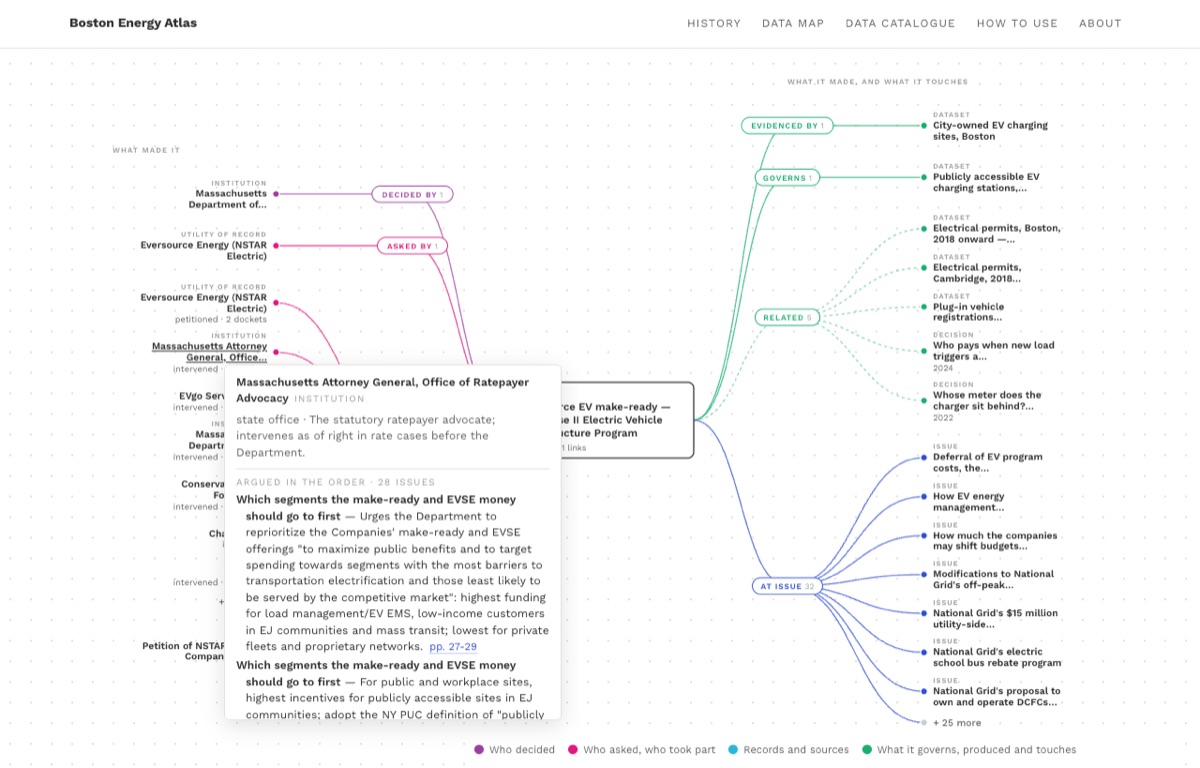
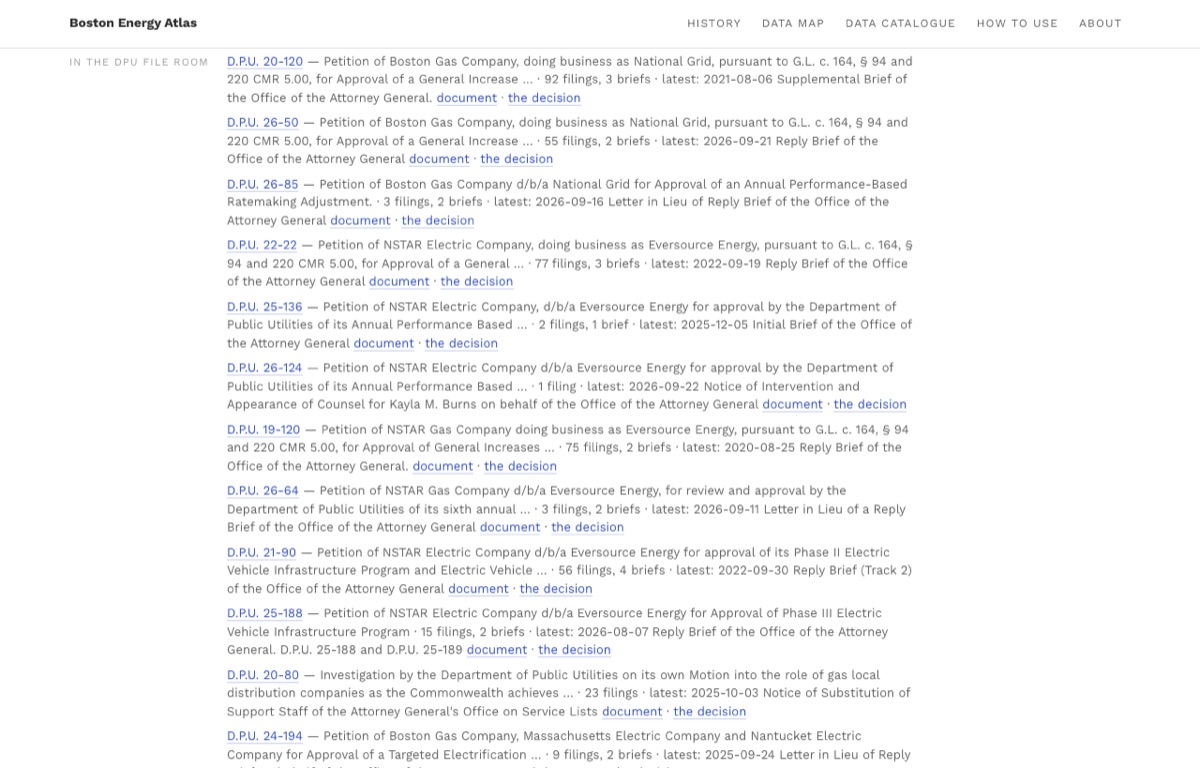
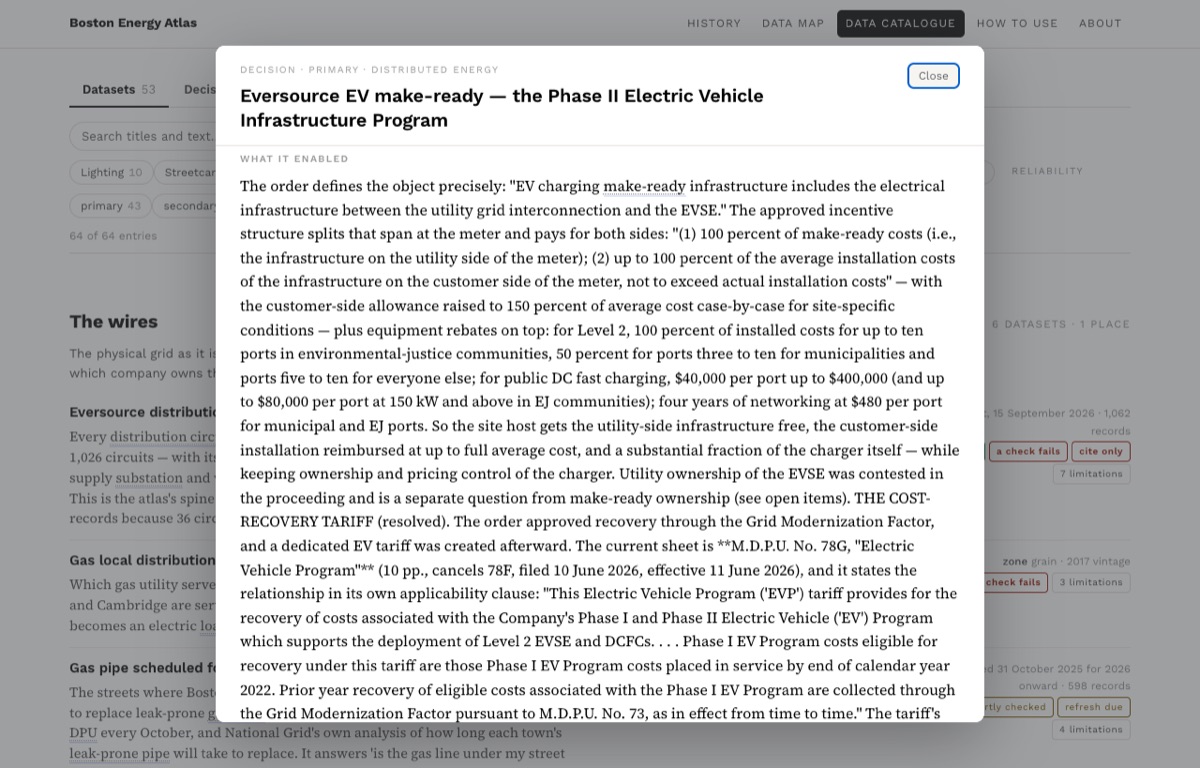
Read it step by step insteadscreenshots and text, with a link to each step1Find the order. In the catalogue, under Decisions, the row for the EV order says who decided, who asked, that 29 parties took part and that 32 issues were decided. Open the entry for the record: what was decided, what it enabled, who paid. open this step →2Who argued. On the decision map, hover the Attorney General in the “Took part” branch. She argued 28 of the 32 issues; each line is her position as the order summarises it, with the page that opens the order there. Below that, what her office filed on the docket, each brief and testimony linked where it sits in the DPU’s file room. open this step →3One question. Click the issue on cost recovery. Its map shows the four parties who argued it (the order groups Eversource and National Grid as one voice; the atlas keeps them as two) and the order it belongs to. open this step →4What was decided. Below the map: the Attorney General asked the Department to deny the deferral as inconsistent with its accounting rules (p. 191); the companies said deferral would “moderate customer bill impacts”. The Department denied it: “Department precedent does not allow for the deferral of prospective expenses” (pp. 192–199), and made Eversource recover through a separate factor with its own bill line. The record says whose view prevailed only because the order does.5The documents. The Attorney General’s own page lists every docket in the atlas she took part in, with the latest brief in each linked to the file room, and the atlas’s decision for each. open this step →
What the advocate learns
Yes. The Attorney General argued against the deferral, and the order adopted her position: no deferral, and a separate EV programme factor that shows on the bill as its own line. The reason the cost is visible at all is this argument.
Where it stops
Each position is the Department’s summary of a brief, and the brief itself, though linked, has not been read by the atlas. “Did it work” is answered only where the order says whose view it adopted; influence that the order does not acknowledge is not on the map.
A city energy manager · an Eversource town
We want chargers on municipal land. What does the EV order give a municipality, and who argued for more?
The town has car parks and a depot. What does Eversource’s programme pay for on municipal sites, were the environmental-justice targets made binding, and did any municipal body get what it asked for?
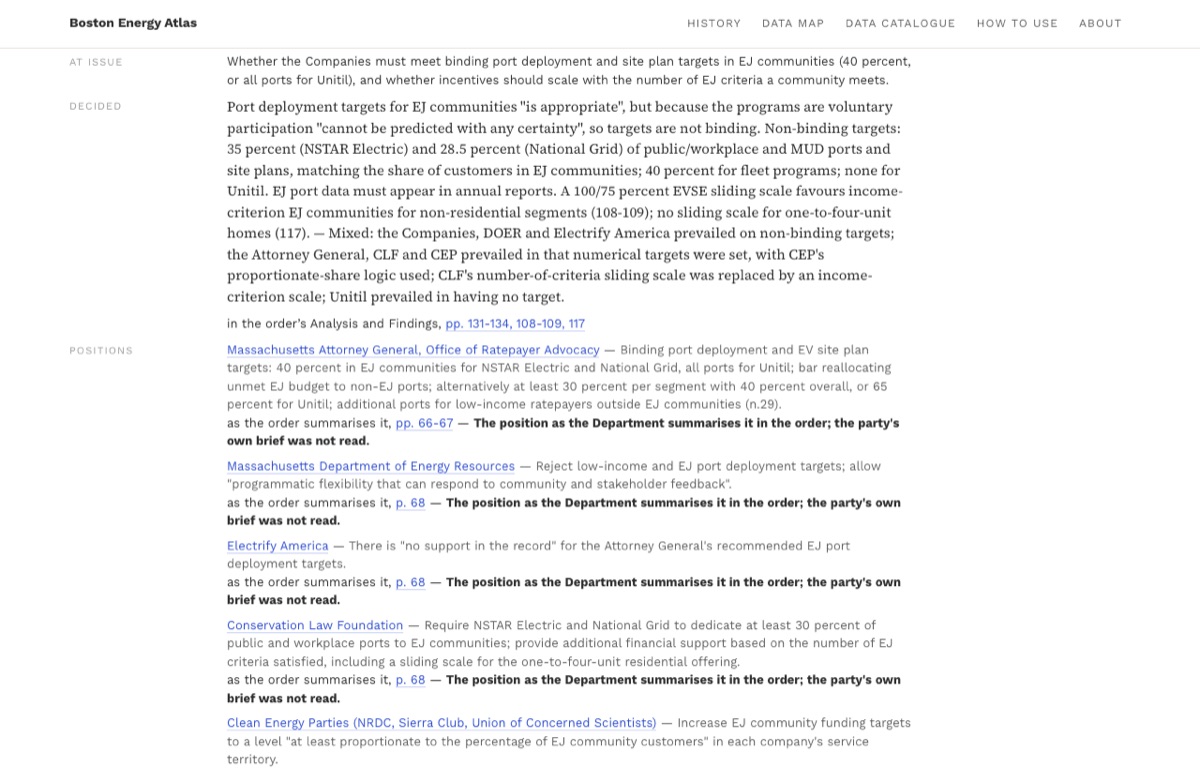
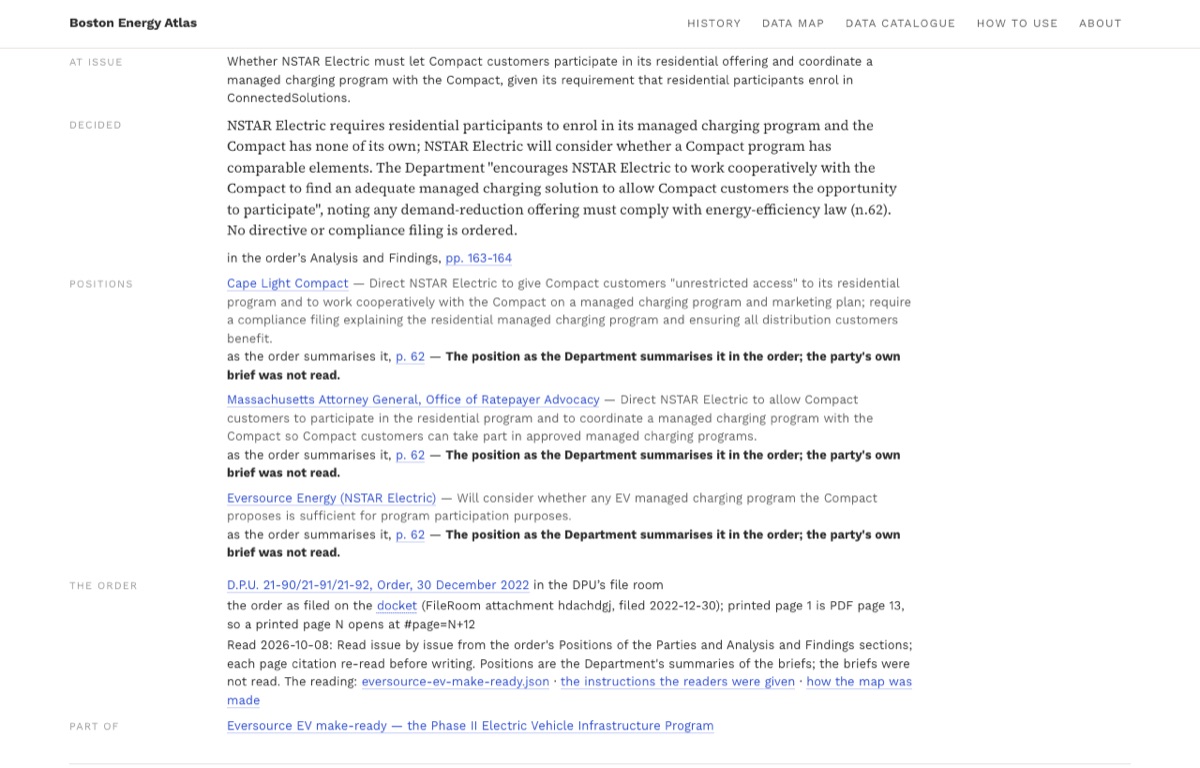
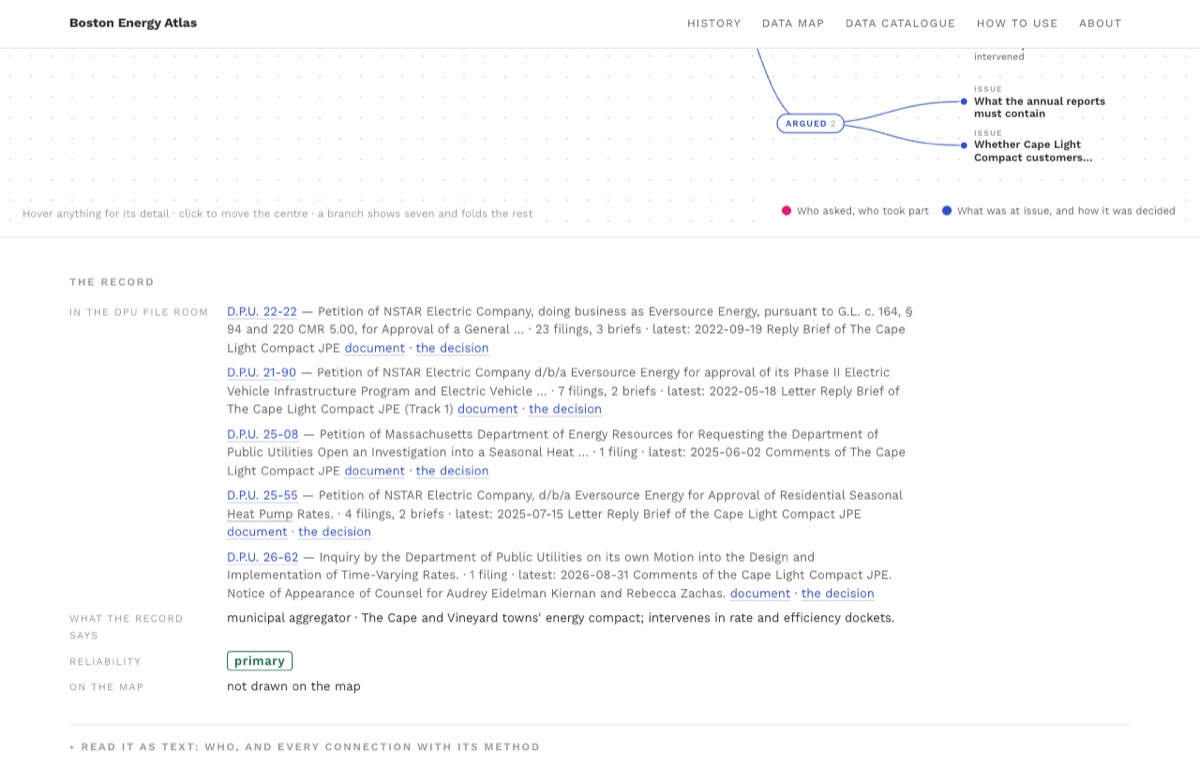
Read it step by step insteadscreenshots and text, with a link to each step1What it pays for. The catalogue entry, under “What it enabled”: the utility side of the meter at 100 percent, the customer side up to the average installation cost, and equipment rebates on top: Level 2 ports at 100 percent for up to ten ports in environmental-justice communities and 50 percent for ports three to ten for municipalities, with four years of networking at $480 a port for municipal and EJ ports. open this step →2The targets. On the decision map, open the issue “Whether EJ community port targets should be binding, and how EJ incentives should be tiered”. Seven parties argued it. open this step →3Who wanted what. The Attorney General asked for binding targets of 40 percent in EJ communities; CLF for 30 percent and a sliding scale; DOER, Electrify America and the companies against binding targets. The Department set targets but made none binding: 35 percent for Eversource and 28.5 percent for National Grid, the share of their customers in EJ communities, with a 100 to 75 percent sliding scale by income criterion (pp. 131–134). Both sides prevailed in part, and the record says so.4The one municipal body in the case. The Cape Light Compact, the Cape’s municipal aggregator, asked with the Attorney General for its customers’ “unrestricted access” to Eversource’s residential offering and a compliance filing. The Department “encourages NSTAR Electric to work cooperatively with the Compact” and ordered neither (pp. 163–164). open this step →5What a municipal body files. The Compact’s own page: the decisions it took part in and, for each docket, how many filings and briefs, the latest one linked in the file room. A town preparing to intervene can read what one looks like. open this step →
What the manager learns
What the programme pays for on a municipal site, that the environmental-justice targets were set but not made binding, and that the only municipal body in the case was encouraged rather than ordered. No city appears among the 21 parties on the docket.
Where it stops
The rebate figures are the atlas’s reading of the order, not the tariff sheet a site host signs; the current sheet is named in the record. Whether a particular town’s sites qualify as EJ communities is a state designation the atlas draws but did not decide.
How the map these three routes end in was made, source by source, is on the methodology page. What the atlas chooses to show, and what it leaves out, is on the About page.